
Facilities and compliance teams have more asset data than ever — and less confidence in what to do with it. Work orders pile up, spreadsheets multiply, and capital planning still feels like guesswork. The problem isn’t a lack of information. It’s that most organizations are managing assets reactively, one week at a time, rather than analyzing them strategically across their full lifecycle. A lifecycle-first approach changes that, and it doesn’t just reduce costs. It changes how you get ahead of risk instead of reacting to it.
See the Full Picture — Optimize Across Your Portfolio
When assets are managed in silos, patterns stay hidden. Lifecycle analysis (LCA) surfaces what siloed views can’t: which assets are past their optimal performance window, which still have runway, and where should capital flow next — replace, refurbish, or extend?
There’s another advantage that often gets overlooked. When you’re managing thousands of the same asset type across your portfolio, lifecycle data gives you negotiating power. If your data shows that a specific asset class is consistently underperforming against vendor specifications, that’s leverage — for better pricing, extended warranties, or improved service terms. You can’t make that case without portfolio-wide visibility.
You can’t optimize what you can’t see across the full lifecycle.
Standardization = Data You Can Trust
Lifecycle analysis is only as good as the data feeding it. If a condition score of 5 in one system means something different than a 5 in another, your analysis is already broken before it starts — and the capital decisions that follow will be too.
Standardizing how assets are described, scored, and tracked creates the data continuity needed for meaningful analysis. This matters especially during asset transitions. If your data shows that a specific asset class consistently required unplanned maintenance every 18 months, that pattern should inform how you plan for and budget around its replacement — not get lost when the old asset is retired.
Standardization isn’t a cleanup project — it’s a competitive foundation.
Smarter Maintenance, Not More Maintenance
Proactive maintenance plans are smarter when they start with lifecycle context, not just maintenance history. An asset’s age, condition, criticality, and expected remaining life all shape what kind of intervention makes sense — and when. Without those inputs, even well-intentioned maintenance can become reactive in disguise, applying the same effort across assets with very different risk and value profiles.
When lifecycle data informs the plan, maintenance stops being a routine expense and becomes a lever for asset performance. The right work at the right time can extend useful life, stabilize cost, and delay unnecessary replacement. Every work order becomes a more deliberate investment when it’s tied to remaining useful life. You’re not just maintaining assets — you’re managing spend relative to value.
Maintenance strategy should be informed by asset lifecycle, just as lifecycle informs maintenance.
New Advantages — Including the Risk You Can’t Afford to Ignore
Lifecycle intelligence creates leverage well beyond the maintenance team. Age and performance data by asset type feeds directly into ESG reporting and carbon footprint tracking — increasingly a boardroom priority. Condition documentation and audit trails simplify compliance reporting and reduce regulatory exposure. And procurement teams negotiating vendor contracts are far better positioned when they walk in with real performance data rather than assumptions.
But perhaps the most immediate advantage is risk visibility — and this is where lifecycle analysis gets concrete.
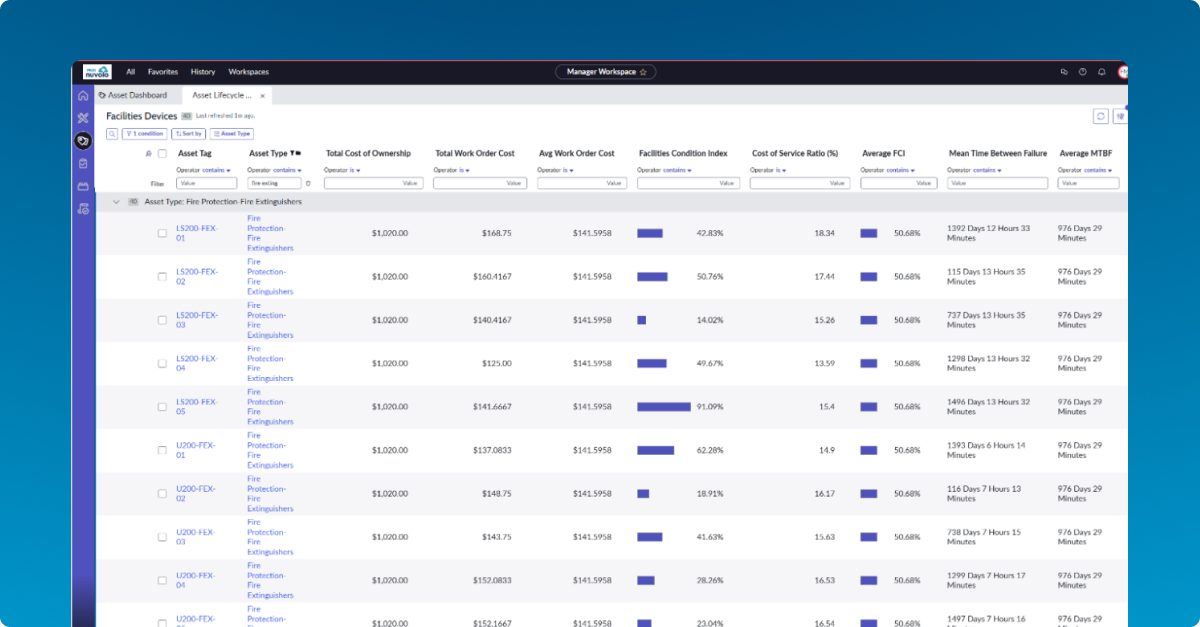
The Asset LCA view in Nuvolo surfaces risk scoring, end-of-life flags, and cost-to-maintain versus replace thresholds — all in one place. Unmanaged lifecycle risk doesn’t stay abstract for long. It shows up as unplanned capital expenditures, compliance gaps, and operational disruptions that could have been anticipated and avoided. The LCA view turns risk from a feeling into a data point — flagged, prioritized, and assigned before it becomes a crisis.
Lifecycle intelligence creates leverage — in boardrooms, audits, and vendor negotiations. And it starts with knowing where your risk actually is.
What’s Available: Nuvolo 2026 R1
Nuvolo’s 2026 R1 release, released in May 2026, introduces purpose-built Asset Lifecycle Analysis capabilities that close the loop between risk visibility and decisive action. Two features anchor the release:
Asset Risk Matrix — Visualize risk across your entire asset portfolio in a single view. Score, segment, and prioritize assets by criticality, condition, and compliance exposure so the right assets get attention at the right time.
Lifecycle Analysis Report — A structured report that maps each asset’s current lifecycle stage, projected end-of-life, maintenance cost trajectory, and replacement triggers — giving teams the documentation they need for capital planning, compliance, and strategic decision-making.
You’ve been managing assets. With 2026 R1, you can analyze and act on your entire portfolio with confidence.
Our first product release of 2026 introduces the Asset Risk Matrix and Lifecycle Analysis Report — purpose-built to help you reduce risk, plan smarter, and act with confidence.
Contact us to Learn MoreOur first product release of 2026 introduces the Asset Risk Matrix and Lifecycle Analysis Report — purpose-built to help you reduce risk, plan smarter, and act with confidence.
Contact us to Learn More