
Maintenance work orders are the backbone of any maintenance operation. They define what work needs to be done, how it should be performed, and how that work is tracked overtime.
But without clear workflows and structured maintenance work order programs, even well-documented tasks can become inconsistent, difficult to track, and disconnected from broader asset strategy.
Understanding how maintenance work orders and workflows work together helps facilities teams improve execution, strengthen preventive maintenance work order programs, and gain better visibility into asset performance.
What Maintenance Work Orders Really Represent
At the most basic level, a maintenance work order is a request to perform maintenance on an asset, piece of equipment, or facility system. In practice, it becomes the operational record that documents how maintenance work is planned, executed, and completed.
Well-structured maintenance work orders typically capture:
- Asset identity, location, and hierarchy
- Description of the issue or maintenance task
- Technician assignments and labor time
- Parts and materials used
- Priority levels and response timelines
- Safety or compliance requirements
- Completion notes and timestamps
Every completed work order adds to the historical record of an asset. Over time, that data helps organizations identify patterns, refine maintenance strategies, and make better operational decisions.
When maintenance work orders are incomplete or inconsistent, that intelligence disappears. Instead of building asset insight, maintenance teams are left with fragmented records that offer little strategic value.
Understanding Maintenance Workflows
If a maintenance work order documents the work, the workflow defines how that work moves through the organization.
A structured workflow typically defines:
- How maintenance requests are submitted
- How work orders are reviewed and prioritized
- When approvals are required
- How tasks are assigned and scheduled
- What documentation must be captured before closure
Without clearly defined workflows, maintenance work orders often move through informal channels such as emails, verbal requests, or manual reassignment. This lack of structure can lead to delays, inconsistent prioritization, and missing documentation.
Digital workflows solve this by ensuring every maintenance work order follows a consistent process. The result is greater accountability, improved coordination between teams, and more reliable operational data.
For more tips on improving maintenance work orders and workflows, read: 10 Best Practices for Work Order Management.
Standardizing Maintenance Work Order Programs Across Locations
When workflows vary across facilities or departments, it becomes difficult to compare performance across the organization. Leadership loses visibility into operational trends, and maintenance programs become reactive rather than strategic.
Structured workflows introduce operational discipline, while standardized workflows allow organizations to measure performance consistently across sites.
As maintenance programs grow, many organizations focus on aligning processes across locations so that maintenance work orders are created, routed, and documented the same way everywhere. Our article on Standardizing Work Orders and Maintenance Workflows Across Your Enterprise explores how organizations can achieve this level of consistency.
The Evolution of Maintenance Work Order Programs
| Maturity Stage | How Work Orders Are Created | Workflow Structure | Operational Visibility | Business Impact |
| 1. Reactive | Maintenance work orders are created after equipment fails or issues are reported. | Informal processes managed through email, calls, or manual coordination. | Limited visibility into maintenance activity or asset performance. | Frequent downtime and unpredictable maintenance costs. |
| 2. Digitized | Maintenance work orders are logged in a CMMS or tracking system. | Basic workflows exist but may vary between teams or locations. | Improved tracking of work orders, but reporting is inconsistent. | Better documentation but limited operational insight. |
| 3. Standardized | Work orders follow consistent templates and classification standards. Preventive maintenance work orders are scheduled systematically. | Defined workflows ensure requests are reviewed, prioritized, assigned, and completed consistently. | Leadership can compare performance across facilities and assets. | Improved efficiency, reliability, and planning accuracy. |
| 4. Automated & Intelligent | Preventive maintenance work orders and inspections are automatically triggered based on schedules, usage, or asset conditions. | Workflow routing, approvals, and escalations are automated. | Real-time dashboards provide visibility into asset performance and maintenance trends. | Predictive insights support proactive maintenance and better capital planning. |
Turning Maintenance Work Orders Into Strategic Insight
Maintenance work orders do more than organize daily tasks. When captured consistently, they generate valuable data that supports long-term asset management decisions.
Historical work order data helps organizations analyze:
- Asset reliability and failure patterns
- Preventive maintenance effectiveness
- Maintenance cost trends
- Risk exposure across asset classes
- Optimal timing for equipment replacement
Every completed maintenance work order contributes to a dataset that informs better operational and financial decisions.
This is why maintenance work order programs should never be treated as administrative processes. They are foundational components of modern asset management.
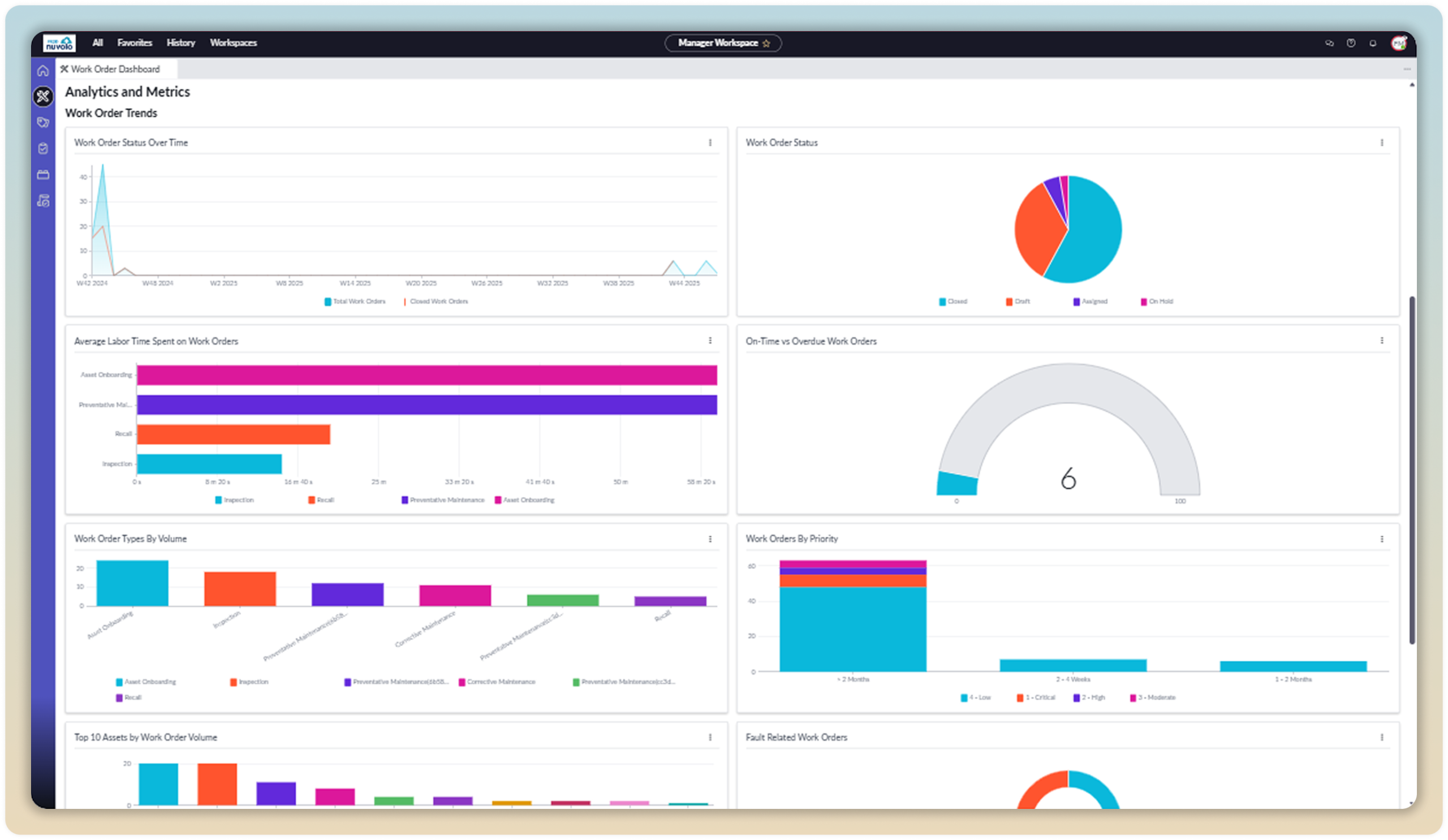
The Work Order Dashboard in Nuvolo’s Facilities Manager Workspace, helps facilities managers spot trends like labor time on specific types of work, the assets worked on most, and priorities across their facilities.
This shift helps teams move beyond day-to-day work tracking and toward a clearer view of asset performance and resource allocation, so they can plan proactively and continuously optimize their overall maintenance strategy.
Simplifying Maintenance Work Orders with the Right Platform
As maintenance operations grow more complex, managing maintenance work orders through spreadsheets, email, or disconnected systems becomes increasingly difficult. Teams need a centralized platform that supports structured workflows, captures consistent data, and provides visibility across the entire asset portfolio.
Work management is a core capability within Nuvolo’s Asset and Maintenance Management product, helping facilities teams streamline how maintenance work orders are requested, prioritized, assigned, and completed. By bringing workflows, asset data, and reporting into a single platform, organizations can standardize maintenance work order programs across sites and gain better insight into asset performance.
Reach-out for a demo so you can see it in action: Request a demo.
One centralized place for technicians to view and complete all of their work orders.
Take a TourOne centralized place for technicians to view and complete all of their work orders.
Take a Tour