
Artificial intelligence (AI) is changing how facilities are managed, maintained, and optimized. For many organizations, AI marks a shift from reactive work towards proactive, data-driven operations. But to apply it effectively, teams need a clear understanding of what AI is, how it works, and the foundation needed before adoption can take place.
The Current State of AI in Facilities Management
Although interest in AI is high, adoption is still early. FacilitiesNet reports that in a 2024 JLL survey, 59% of organizations did not yet have a formal AI strategy. At the same time, early adopters were already seeing measurable results. Deloitte found that predictive maintenance programs can increase uptime by 10 to 20% and speed up planning cycles by 20 to 50%. These early outcomes show why facilities leaders are exploring AI more seriously and why understanding the fundamentals, data requirements, and use cases is essential before getting started.
This guide explains the fundamentals of AI in facilities management, how to prepare your data and systems, the potential ROI, and the emerging technologies shaping its future.
AI in Facilities Management Defined
AI in facilities management refers to the use of advanced algorithms and data models to analyze large volumes of information from building systems, assets, and operations. The goal is to provide facilities teams with clear, actionable insights and recommendations so teams are free to focus on their more pressing tasks, while also improving long-term ROI decisions.
By processing data in real time, AI delivers significant value to facilities teams that are often understaffed or lack dedicated data analysts. It can identify patterns, detect anomalies, and surface recommendations that help teams make faster, more informed decisions, ultimately improving efficiency, reliability, and overall performance.
Examples of AI in practice
- Predictive Maintenance: Predicting when equipment is likely to fail so maintenance can be scheduled in advance.
- Autonomous Operations: AI automatically adjusting HVAC and lighting settings based on occupancy and energy demand.
- Virtual Assistants: AI agents grouping and prioritizing work orders according to urgency, risk, or operational impact to free up technicians to focus on maintenance.
- Predictive Analytics: AI analyzing utilization data to make space optimization and cost reduction suggestions that will achieve desirable results.
- Anomaly Detection: AI monitoring equipment performance and environmental conditions in real time to detect anomalies that may impact safety, compliance, or service quality.
How to Prepare for AI
JLL’s research challenges the popular belief that AI is a “leapfrog” technology. Many leaders hope AI will let organizations with outdated systems skip gradual upgrades and move straight to advanced capabilities. Instead, JLL finds that AI is widening the gap between digital leaders and laggards. Companies that already have strong, modern technology foundations are achieving superior AI outcomes, while those with legacy systems are falling further behind.
Complementary research reinforces why this gap is growing. Organizations that invest in strengthening their data foundations are able to better leverage AI tools and translate them into measurable results, including maintenance cost reductions of nearly 25% and energy savings of around 20%. Together, these findings show that AI success depends less on leapfrogging and more on building the right data and technology foundations first.
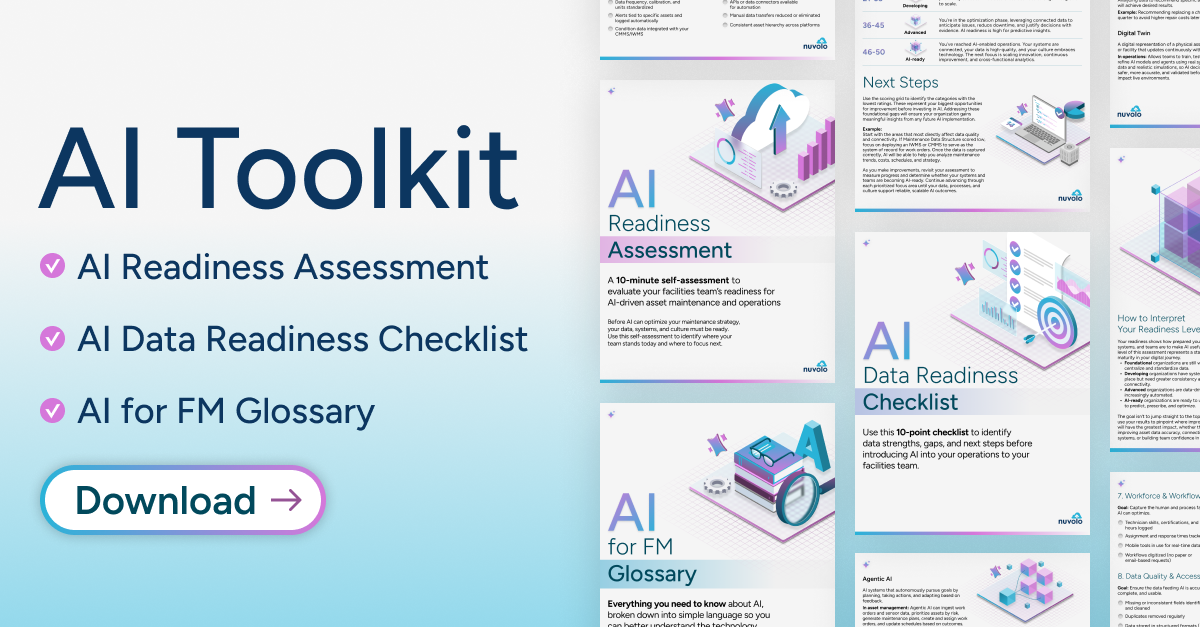
Steps to prepare for AI adoption
- Technology foundation: Start by ensuring you have the right technology stack in place. Legacy, disconnected systems limit what AI can do. Consolidate onto an integrated platform that centralizes asset data, work orders, energy, and space information so AI has a single, reliable source of truth.
- Data accuracy: AI is only as good as the data it consumes. Maintain accurate, up-to-date asset records, work orders, and maintenance histories so AI outputs are trustworthy and actionable.
- To learn more about why a reliable data foundation is necessary before implementing AI, checkout this resource: Your Asset Management AI Strategy Requires a Solid Data Foundation – Here’s Why.
- Standardization: Standardize data across sites, buildings, and departments. Use consistent fields, naming conventions, and classifications so AI models can see the full picture instead of fragmented, site-specific views.
- Governance: Establish clear governance around data and AI use. Define ownership for data collection, validation, and updates, monitor AI recommendations and workflows for accuracy, and ensure privacy, security, and compliance policies are followed as the technology scales.
- Goal alignment: Align leadership, facilities teams, and key stakeholders on what you want AI to achieve. Are you aiming to reduce manual data entry, speed up reporting, improve space utilization, or enable predictive maintenance? Clear goals keep AI projects focused and measurable.
The ROI of AI for Facilities Management
AI delivers the strongest ROI when it is aligned with organizational priorities. Because facilities teams often face multiple challenges at once, it is important to define what matters most before choosing a solution.
If your primary goal is to reduce administrative time, look for tools that automate data entry, reporting, and work order organization. If unexpected downtime is your biggest concern, prioritize predictive maintenance capabilities. If sustainability goals are a growing focus for leadership, AI that improves energy performance may offer the best return.
Key areas where AI delivers measurable value
- Increased uptime: Predictive maintenance helps prevent failures and extend asset life.
- Lower operational costs: AI-driven insights reduce maintenance spending and energy consumption.
- Improved productivity: Automated reporting and smarter scheduling give technicians more time in the field.
- Sustainability and compliance: AI supports accurate tracking of emissions, refrigerant use, and regulatory requirements.
Why Data is Key
These benefits depend on having reliable, consistent data. AI can only make useful recommendations when the information behind it is complete and accurate, which is why a strong data foundation plays such an important role in achieving ROI.
To build a strong business case, facilities leaders should focus on three essentials:
- Data readiness
- Clear, measurable ROI goals
- Integration that works smoothly with existing systems
When these pieces are in place, AI can scale efficiently and deliver sustainable value.
How AI Supports Sustainability Goals in Facilities Management
Sustainability has become a strategic priority for facilities leaders, but achieving meaningful progress requires more than tracking energy use. One of the biggest opportunities is predictive maintenance. By analyzing asset performance and identifying potential issues before they become failures, AI helps teams reduce unnecessary maintenance, minimize downtime, lower energy consumption, and avoid premature equipment replacement. The result is a more efficient operation that supports both sustainability initiatives and long-term cost savings.
Learn how predictive maintenance is helping facilities teams improve reliability while advancing their environmental goals in our guide, How AI Is Helping Facilities Leaders Achieve Sustainability Through Predictive Maintenance.
Emerging AI Trends in Facilities Management
The next phase of AI in facilities management is moving from individual use cases to more connected, intelligent operations. As data quality and integration improve, several AI-powered technologies are creating new opportunities for efficiency, insights, and automation.
- Generative AI for Knowledge and Reporting: AI can turn natural language prompts into maintenance summaries, asset reports, and clear explanations of building performance. This reduces the time teams spend gathering data and writing documentation.
- AI Co-Pilots for Maintenance and Operations: AI assistants can recommend next steps, point out risks, organize work orders, or handle routine data entry so teams can work faster and stay focused on higher-priority tasks.
- AI for Autonomous and Self-Optimizing Buildings: AI can connect with building automation systems to adjust HVAC, lighting, and utilities based on occupancy patterns, weather, or equipment conditions. This supports comfort, energy efficiency, and more consistent operation.
- AI-Driven Predictive Maintenance: AI reviews sensor data, maintenance histories, and asset performance to predict issues earlier and recommend the right time for service. This helps reduce unexpected downtime and keeps equipment running longer.
- AI-Enhanced Digital Twins for Simulation and Planning: AI powers digital twins by interpreting real-time data from equipment and building systems. This allows teams to test different scenarios, forecast maintenance needs, identify performance issues, and evaluate energy impacts without interrupting daily operations.
Organizations that invest in connected data, training, and governance can use these AI capabilities to shift from reactive management to proactive, continuously optimized operations.
For an overview of the different types of AI and how facilities and workplace leaders should implement them to see ROI, read The Facilities and Workplace Leader’s Guide to AI Implementation That Actually Delivers.
Conclusion
AI can help facilities teams shift from managing day-to-day issues to building smarter, more resilient operations. Whether the goal is to reduce maintenance costs, improve sustainability, or increase reliability, success depends on a connected data foundation and a clear implementation strategy.
Get Your Data Ready for AI with Nuvolo
Before AI can deliver accurate insights or recommendations, your data needs to be reliable, standardized, and connected. Nuvolo helps facilities teams clean up asset data, streamline maintenance histories, and centralize information across buildings so AI tools have a strong foundation to work from.
If your organization is ready to take the next step with AI, Nuvolo can help you build the clean, connected data foundation you need to achieve reliable results and long-term success. Contact us today to get started.
FAQs
1. What is AI in facilities management?
AI in facilities management refers to using data, algorithms, and automated tools to help teams maintain buildings more efficiently. It analyzes information from assets, work orders, sensors, and building systems to provide recommendations, predict issues, and automate tasks so teams can make faster, better decisions.
2. How can AI improve maintenance and reduce downtime?
AI can review equipment data, maintenance histories, and sensor readings to predict when an asset is likely to fail. This helps teams schedule repairs before breakdowns happen, which leads to fewer interruptions, safer operations, and longer equipment life.
3. What data do you need for AI to work in facilities management?
AI needs accurate, consistent, and connected data to produce reliable insights. This includes asset details, maintenance histories, work orders, space data, and energy information. Clean data helps AI understand patterns, detect issues, and make trustworthy recommendations.
4. How do you know if your organization is ready to adopt AI?
Your organization is ready for AI if you have a modern system of record for assets and maintenance, standardized data across buildings, and clear goals for what AI should improve. Most teams start with predictive maintenance, energy optimization, or reducing administrative work.
5. What are the biggest benefits of using AI in facilities management?
The top benefits include higher uptime, lower maintenance and energy costs, better productivity for technicians, and improved sustainability tracking. AI helps teams move from reactive work to more proactive, long-term planning.
Understand what AI needs, where data gaps exist, and how to get started today.
Get the PlaybookUnderstand what AI needs, where data gaps exist, and how to get started today.
Get the Playbook