
When evaluating facilities management software, three acronyms come up again and again: CMMS, EAM, and IWMS. They’re frequently confused, often used interchangeably, and almost never explained side by side in a way that actually helps you make a decision.
All three are designed to help organisations manage physical assets, maintenance operations, and the built environment, but they do so at very different levels of scope. Choosing the right category of facilities management software isn’t just a technology decision. It shapes which teams benefit, what data you can act on, and how well your platform can grow with your organisation.
This guide breaks down CMMS, EAM, and IWMS from the ground up, compares them head-to-head, and gives you a practical framework for deciding which one fits where your organisation is today and where it is going. It’s part of our Complete Guide to Asset and Maintenance Management, where you can explore what it takes to manage your asset & maintenance operations in even more depth.
What Is a CMMS?
A Computerized Maintenance Management System (CMMS) is the most operationally focused of the three categories of facilities management software. Its core purpose is to digitise and streamline maintenance operations by replacing paper work orders, manual PM schedules, and fragmented parts tracking with a centralised system your entire maintenance team can use.
Core CMMS capabilities typically include
- Work order creation, assignment, and tracking
- Preventive maintenance (PM) scheduling
- Spare parts and inventory management
- Maintenance history and audit trails
- Basic asset records (what you own and where it is)
- Mobile access for technicians in the field
A CMMS answers one primary question: “How do we manage maintenance work more efficiently?” It’s built for maintenance managers and technicians: the people executing work on the ground every day.
The limitation of a CMMS is its narrow scope. It generally doesn’t handle real estate, space planning, capital projects, sustainability reporting, or the full financial lifecycle of an asset. When your needs grow beyond maintenance execution, a CMMS alone often hits a ceiling.
What Is EAM?
Enterprise Asset Management (EAM) builds on the CMMS foundation but expands it across the entire lifecycle of a physical asset, from acquisition and commissioning through operation, maintenance, and eventual disposal or replacement.
Where a CMMS asks “what maintenance do we need to do today?”, EAM asks the broader strategic question: “How do we maximise the value of every asset we own, from purchase to retirement?”
EAM is a more comprehensive category of facilities management software, designed not just for maintenance teams but also for asset managers, operations leaders, and finance stakeholders who need visibility into asset performance, depreciation, and capital investment.
To learn more about what EAM encompasses, see our deep dive: What Is Enterprise Asset Management?
EAM capabilities typically include
- Full asset lifecycle tracking (acquisition, depreciation, disposal)
- Capital planning and asset investment forecasting
- Enterprise-wide compliance and audit management across the full asset lifecycle
- Advanced reporting, KPIs, and analytics across asset portfolios
- Integration with ERP systems (finance, procurement, HR)
- Multi-site and multi-asset-class management
EAM is the right choice for organisations managing large, complex, or high-value asset portfolios, including manufacturers, utilities, hospitals, government agencies, and large commercial real estate operators. If compliance, asset depreciation, capital budgeting, or multi-site visibility matter to you, EAM is typically the right category of facilities management software to evaluate.
What Is an IWMS?
An Integrated Workplace Management System (IWMS) is the broadest category of facilities management software. Rather than focusing primarily on assets or maintenance, an IWMS manages the full workplace by connecting real estate, facilities operations, space planning, people, and sustainability into a single platform.
Gartner coined the term “IWMS” in the early 2000s to describe platforms that integrate five functional domains: real estate and lease management, facilities and space management, maintenance management, capital projects, and environmental sustainability. A true IWMS covers all five.
For a full breakdown of what an IWMS is and does, check out: What Is an IWMS?
IWMS capabilities typically include
- Real estate portfolio and lease management
- Space planning, utilisation tracking, and move management
- Workplace reservations (desks, conference rooms, amenities)
- Facilities and maintenance management (overlapping with EAM/CMMS)
- Capital project planning and execution
- Sustainability and energy management
For corporate and hybrid work environments: IWMS is a natural fit for organisations where the workplace itself is a strategic asset. Corporate real estate teams, facility directors, HR, sustainability leaders, and finance all benefit from a single unified system that connects their data. As hybrid work has fundamentally reshaped how office space is used, IWMS platforms have become essential for organisations rightsizing their real estate footprint, tracking space utilisation, and delivering a consistent employee experience across locations.
For regulated industries: The value of an IWMS extends well beyond corporate real estate. In industries like healthcare and life sciences, where facilities directly impact patient safety, regulatory compliance, and accreditation, an IWMS provides the integrated visibility that a standalone CMMS simply cannot. Hospitals, for example, need to connect clinical equipment maintenance, real estate portfolios, capital projects, and compliance documentation in one place. When those pieces live in separate systems, the gaps between them become compliance risks. See how this plays out in practice in our guide to selecting the right healthcare facilities software.
Where CMMS, EAM, and IWMS Overlap
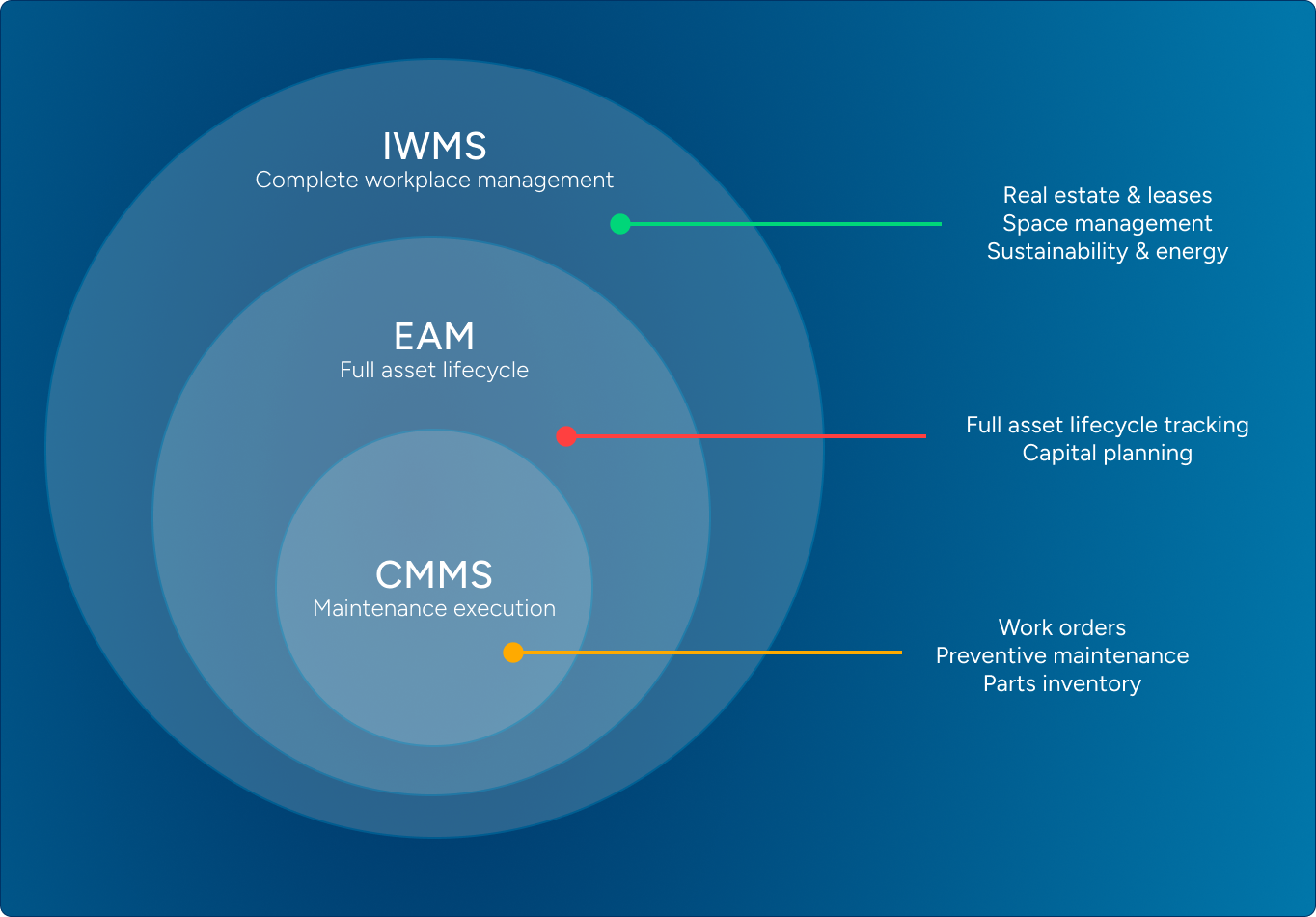
The confusion between these three categories of facilities management software is understandable, as there is genuine overlap in their capabilities and vendors don’t always use these terms consistently.
- CMMS inside EAM: Every EAM platform includes maintenance management functionality. If a vendor calls their product an EAM, you should expect CMMS-level features to be included as a baseline.
- EAM inside IWMS: A true IWMS doesn’t just touch on asset and maintenance management. It encompasses the full asset lifecycle alongside real estate, space, capital projects, and sustainability. That means organisations don’t have to choose between strong maintenance capabilities and broader workplace management. They can have both in a single connected platform.
- The real differentiation: The further you move from CMMS toward IWMS, the more the platform shifts from operational facilities management to strategic management of your entire physical environment, including real estate, capital investments, and sustainability goals.
How to Choose the Right Facilities Management Software: 3 Questions
Before comparing specific vendors, answer these three questions about your organisation:
- What is your primary pain point today? If it’s maintenance chaos, including missed PMs, lost work orders, and no visibility into technician productivity, a CMMS may be the right starting point for your facilities management software search. If your challenges run deeper, read our guide: 10 Questions to Ask Before Choosing Maintenance Management Software.
- How complex is your asset portfolio? A handful of assets in one building is different from thousands of assets across dozens of facilities in multiple countries. Complexity, regulatory requirements, and capital planning needs all point toward EAM or IWMS as your facilities management software category.
- Do real estate and space planning matter to your organisation? If lease management, space utilisation, hybrid work, or real estate portfolio optimisation are on your agenda, you need IWMS capabilities. These fall completely outside the scope of a CMMS, and only partially within EAM.
The Case for Connected Facilities Management Software
One of the most common pitfalls organisations face is starting with a narrow tool, often a CMMS, and eventually needing to layer on real estate, space, or sustainability modules from separate vendors. The result is fragmented data, duplicate records, and point-to-point integrations that constantly need maintenance of their own.
The most successful organisations are moving toward a connected facilities management software platform, like Nuvolo, one that unifies CMMS, EAM, and IWMS capabilities in a single system of record built on a common data model. This eliminates the silos between maintenance teams, facility managers, real estate teams, and sustainability officers. Everyone works from the same data, and strategic decisions reflect the full picture.
When asset data, maintenance history, space utilisation, lease information, and capital plans all live in one platform, the value of each data point multiplies. A maintenance event isn’t just a work order. It’s also input for capital planning, compliance reporting, and sustainability measurement. That’s the difference between facilities management software that supports operations and facilities management software that drives strategy.
Final Thoughts
CMMS, EAM, and IWMS aren’t competing alternatives so much as a spectrum of scope within the broader facilities management software landscape. A CMMS manages maintenance. An EAM manages assets. An IWMS manages the entire workplace. The right choice depends on where your organisation is today and where it needs to go.
For a deeper look at everything that goes into managing assets and maintenance across your organisation, visit our Complete Guide to Asset and Maintenance Management.